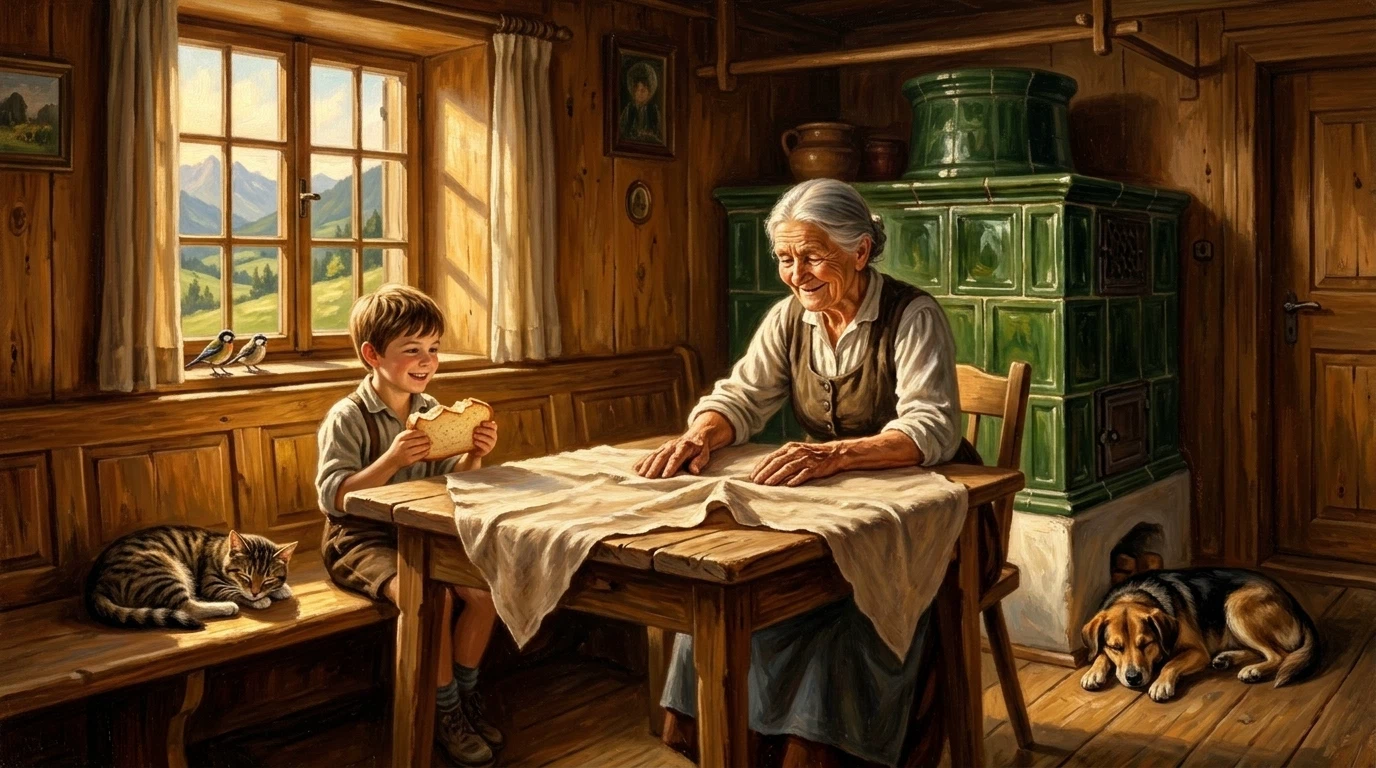
Once upon a time, there was an elderly lady who passed on the same four words to those around her again and again: “Zfrieda muss ma si” — you have to be content.
When the young people sat at the kitchen table complaining about everything that was missing, what new things the neighbor had, or how unfair the world was, she would slowly smooth the tablecloth with her rough hands, smile quietly, and say that sentence.
To many, it sounded like a simple saying of old folks. Like something easily said when you are sitting in a warm parlor and have the hardest part of life behind you.
What hardly anyone knew: this contentment had not been handed to the old lady in her cradle. It was probably the very thing she had had to wrestle for most fiercely herself.
When she was still half a child, there had not been enough at home in the valley to feed every mouth. So they packed a small bundle for her and sent her on foot over the mountains in the spring into foreign parts (as a Schwabenkind). She had served on strangers’ farms, slept in cold chambers, and swallowed her homesickness so deep down until no tears came anymore. She knew what it felt like to be needed only for your hands and to truly belong nowhere.
The scarcity and cold of those years had left deep marks. She belonged to a generation that had not learned to complain about its own pain. You pulled yourself together. You settled it within yourself.
When she later sat at the kitchen table and said, “Zfrieda muss ma si,” it was no cheap consolation. It was her daily decision not to pass the old hardness of the mountains on to the next generation. She did not want her children and grandchildren to carry the same hunger and the same restlessness in their hearts that she herself had had to fight against all her life. So she shared with her grandson again and again the very thing that was probably hardest for her: the permission to come to rest and to find peace in what was there.
The grandson heard the sentence many hundreds of times. As a child, he took it lightly, like a warm piece of bread.
Only many years later, when the old lady had long since ceased to sit at the table, did he understand what she had truly placed into his hand. Those four words were no mere figure of speech. They became his most important school of life — the most precious legacy of a woman who had frozen in foreign lands so that those who came after her could sit warmly in a home of their own.
By René Jochum - LLM Translated. In loving memory of my grandmother. License: CC-BY-4.0.