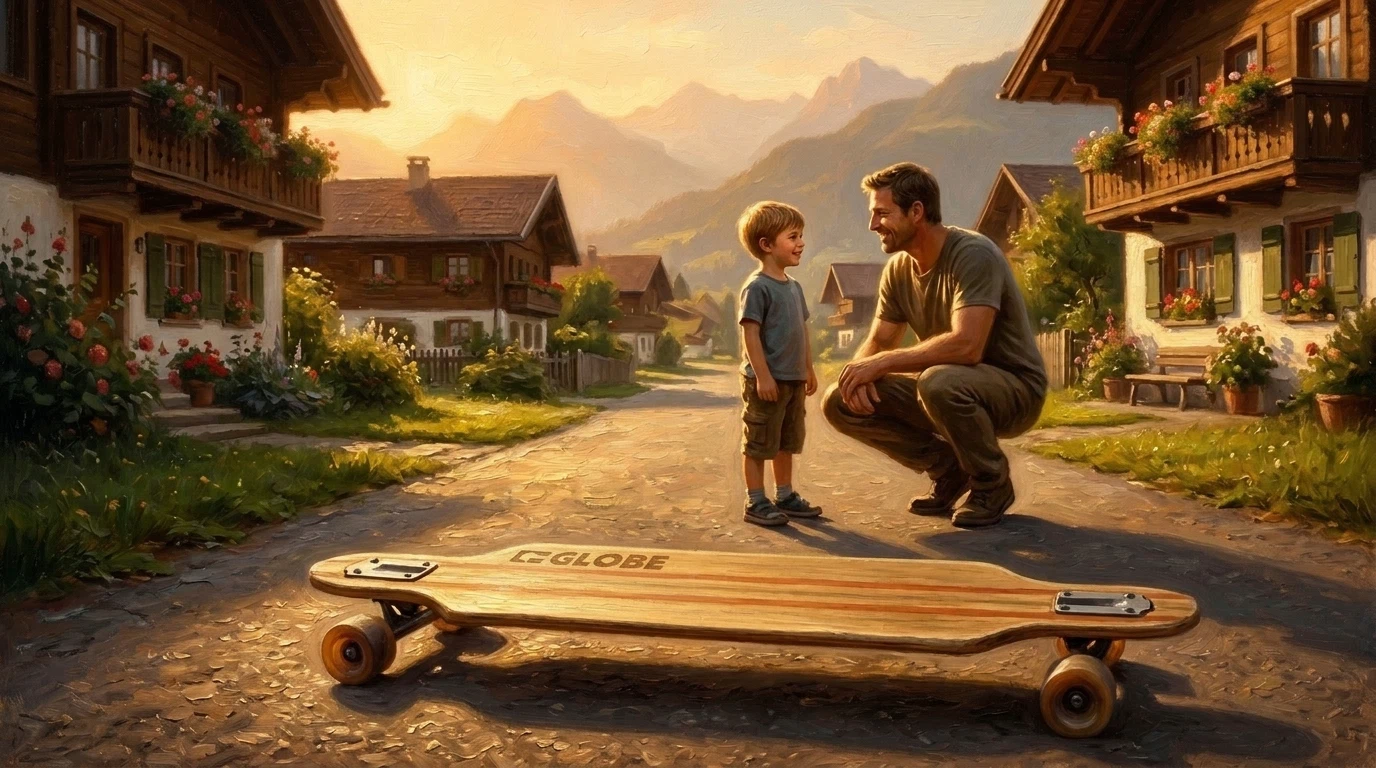
A few days ago, I was out riding my longboard. There is a kid living in the neighborhood with whom I now often do a few laps. When we ran into each other again today, the greeting was not just a simple “Hello.” The kid looked at me and said, as naturally as could be: “I missed you.”
A small sentence, honest and unfiltered. In that moment I am no educator and I am not doing anything special — I am just riding my board. And yet that one sentence made my whole day brighter. It pulls you straight into the here and now.
People often say that raising a child is solely the job of the parents — and later perhaps of the teachers. Everything clearly regulated, responsibilities neatly separated. At most, people talk about how important reliable attachment figures are for the children. What is almost always forgotten, however, is what such moments actually do to us adults.
Today while grocery shopping, a boy stood next to me admiring the Advent calendar in my shopping cart — a protein calendar I had picked up for my sister and my family. I grinned at him and said: “That’ll make you strong!” Right after that, though, I also told him with a wink that the advertising on the box promises a lot more than what is actually inside in the end. No big lecture, no wagging finger — just a brief, honest conversation between two shelves.
Shortly afterward, at the checkout: a toddler was having a proper meltdown. Raging the way children rage when the world is not going their way. In moments like that, you immediately feel the tension in the room — the annoyed glances, the pressure on the parents. I looked at the cashier and a passerby, smiled slightly, and said dryly: “I wasn’t any better when I was a little boy.” That was no heroic deed, just the truth. Yet immediately the tension went out of the air and the faces softened. A little gentleness costs nothing, but it instantly lifts the weight off everyone’s shoulders in the room.
On a larger scale, it works the exact same way in multigenerational houses where older people and children live under one roof. No one there has to “raise” or “save” the other. They simply share their everyday lives. The older people blossom because there is life in the house; the children grow up with a serenity that often falls short in a tightly scheduled family routine.
Perhaps in the end it is not about a romanticized village that knows everything better and meddles in everything. But about a village that does not lecture, yet shares in life. One that makes people gentle without being indifferent. One in which you are not responsible for everything, but for the next small moment.
The real question then might no longer be: “Are only the parents responsible?” — but rather: “Am I part of this village too?”
Everyone has to answer that for themselves. At the latest the next time at the supermarket checkout or out on the street.
By René Jochum - LLM Translated. License: CC-BY-4.0.