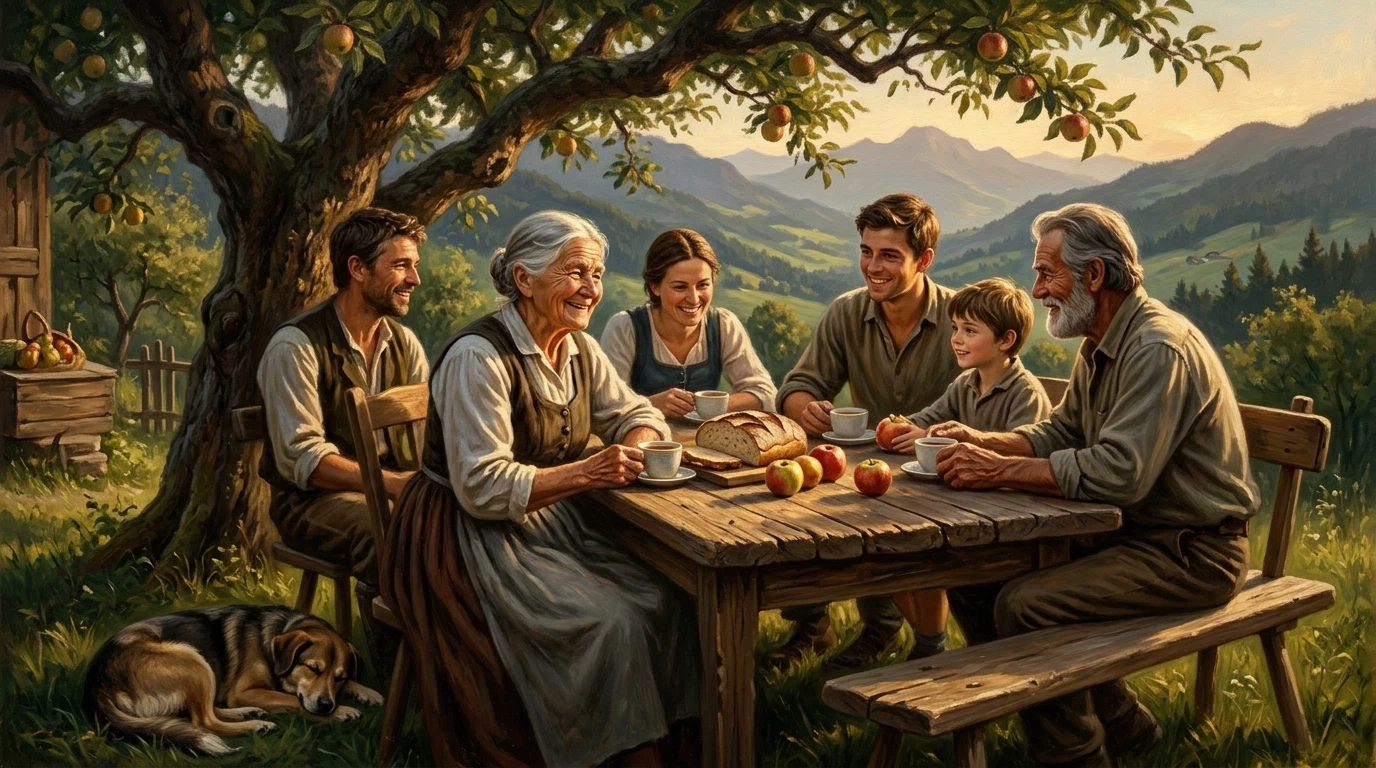
Recently, the question of what a perfect world would look like was asked in an online forum. If you follow the political debates of our days, the answer usually sounds like more speed, more growth, sharper edges, or the next grand system overhaul.
My answer turned out differently. Quieter.
In my perfect village – a region, a country, a continent, or even a world – people are above all one thing: content.
My grandma used to say a sentence to me that has stayed in my ear to this day: “Zfrieda muss ma si.” You have to be content. She belonged to a generation that had little and had to make a lot out of it. Yet in her sentence there was no resignation and no putting up with injustice. In it lay the deep wisdom of knowing when enough is enough – and what calm sets in when you stop constantly chasing the next lack.
In our current political and economic logic, contentment is almost treated as a danger. A system that lives off people constantly feeling inadequate needs restlessness. It needs the fear of decline as a whip and the promise of “even more” as a carrot. Whoever is content, so the secret worry goes, stops consuming, stops making an effort, stands still.
In that same forum, underneath a wish for more humanity and humility before nature, someone immediately wrote the reflexive sentence: “Without economic growth, none of that is affordable.”
I believe that right here lies our greatest fallacy. One does not exclude the other – quite the opposite.
Contentment is the opposite of standstill. Whoever is content has a clear head. A society that no longer has to compete against one another out of inherited existential fear or in constant survival mode does not become lazy – it becomes free. Whoever stands on solid ground and is at peace with themselves does not need to make anyone smaller in order to feel bigger. They once again have the strength to be curious, to build things properly, to take responsibility, and to think beyond their own garden fence. An economy carried by people with a clear head is stronger in the long run than any economy running on wear and tear and fear.
What this takes socially does not need to be listed all over again here – it is that quiet pact at eye level that I tried to capture in Uf a nand luaga: looking out for one another in everyday life, holding space for differences at the same table, respecting the dignity of every living being, and letting five be even once in a while.
In that same forum, someone else summed this up in a quote by Katja Gasser that has stayed with me ever since:
“I believe in the power of precision and the power of generosity. I believe in the power of doubting and of asking questions, in the power of shame and modesty. I believe in the power of mercy and in the unconditional necessity of solidarity and compassion.”
— Katja Gasser
On a grand scale, that may sound far away. Like a utopia for quieter times.
Yet a contented world does not begin in parliament or in Brussels. It begins where we stop letting ourselves be told that we are only good enough when we are out of breath. It begins where we open the door in the morning, how we talk to our neighbour, how we write in a forum, and how we deal with our own fractures.
I am not waiting for the big world to become perfect. I am trying it in my world first.
By René Jochum - LLM Translated. In memory of my grandma and her “Zfrieda muss ma si”. License: CC-BY-4.0.