Once upon a time there was a man whom the people in the village gave a wide berth.
They called him the curmudgeon. When children ran past his garden fence, they grew quiet, and when someone greeted him on the street, at most a terse grumble came back. His gaze always looked first for what was crooked, what was noisy, or what might break.
What nobody in the village knew: the man did not want to be like that at all.
His whole goal, his only anchor in the dark years, was the memory of his late wife. She had been his exact opposite – a person full of cheerfulness who found a reason for joy even in the smallest things. He wanted to be like her. Friendly. An open part of the village. Yet life had taken too much from him over the years, and every blow of fate had settled like a thick crust around his heart. The more he forced himself to be as light and warm-hearted as she had been, the more painfully he felt his own failure. His strictness toward the outside world had long since become an unforgiving hardness toward himself.
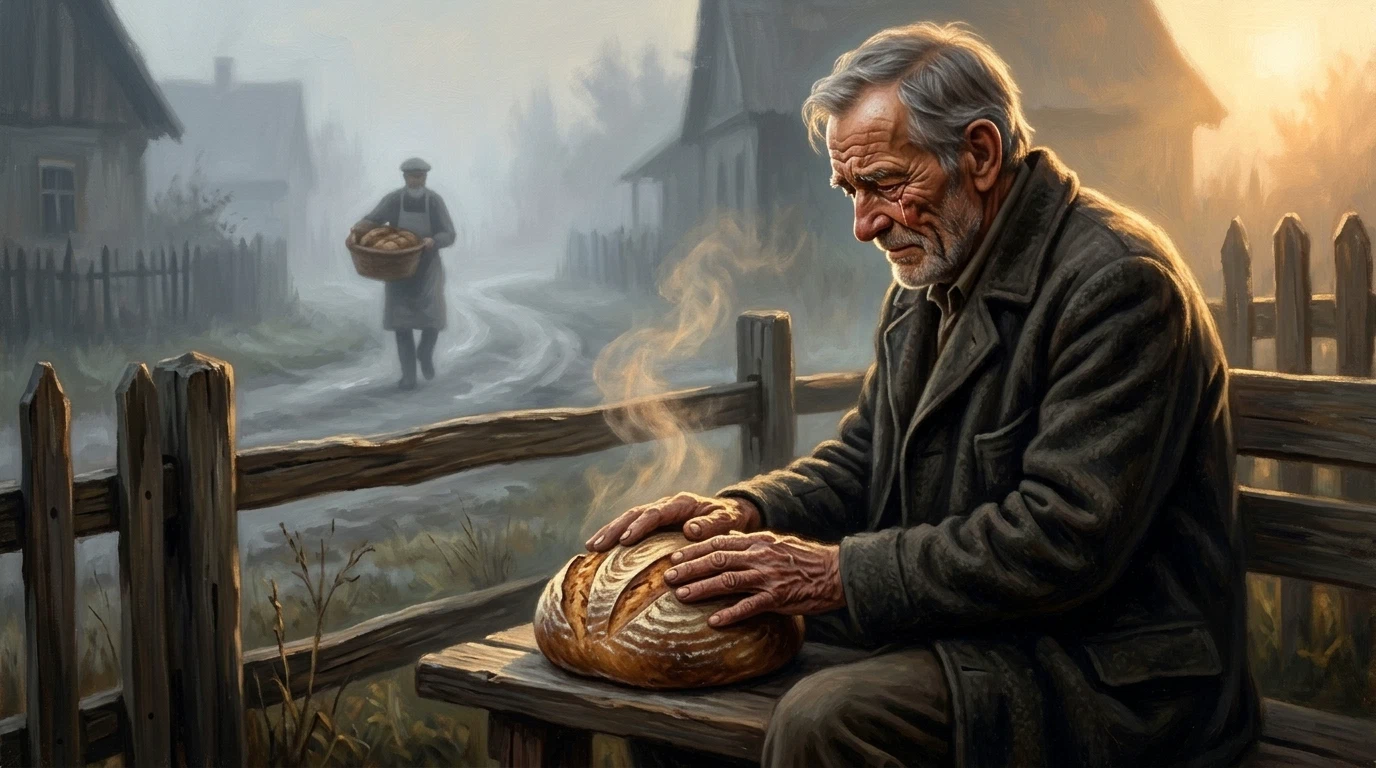
One cold morning he sat alone on the bench in front of his house. He looked at his clenched hands and brooded over how far he had drifted from her example, how cold and narrow it had become inside him. He condemned himself for his bitterness – and in doing so only grew more bitter still.
Then he heard footsteps on the path. It was the baker from across the way, already making his early rounds. The old man tensed up inside, ready for the familiar, dismissive look. Yet the baker stopped by the fence, reached into his basket, wordlessly placed a still-warm loaf of bread beside the old man on the bench, nodded to him calmly, and walked on.
The old man sat there, stared at the bread, and slowly laid his cold hands against the warm crust.
In that quiet moment, he understood why he had failed all those years. He had tried to imitate his wife’s kindness on the outside while sitting in merciless judgment over himself on the inside. Yet the inside always mirrors itself outward; you cannot give the world a peace that you deny yourself.
The next morning, the old man stood by the fence again. When the baker walked past, he did not grumble and he did not look down at the ground. He raised his head, looked him in the eyes, and said quietly: “Thank you.”
It was only a single word, still unfamiliar and rough. But he had understood how his wife’s radiance had truly come into being: through mercy, his inner hardness slowly healed, and through gratitude, the light returned to his face all on its own.
By René Jochum - LLM Translated. License: CC-BY-4.0.