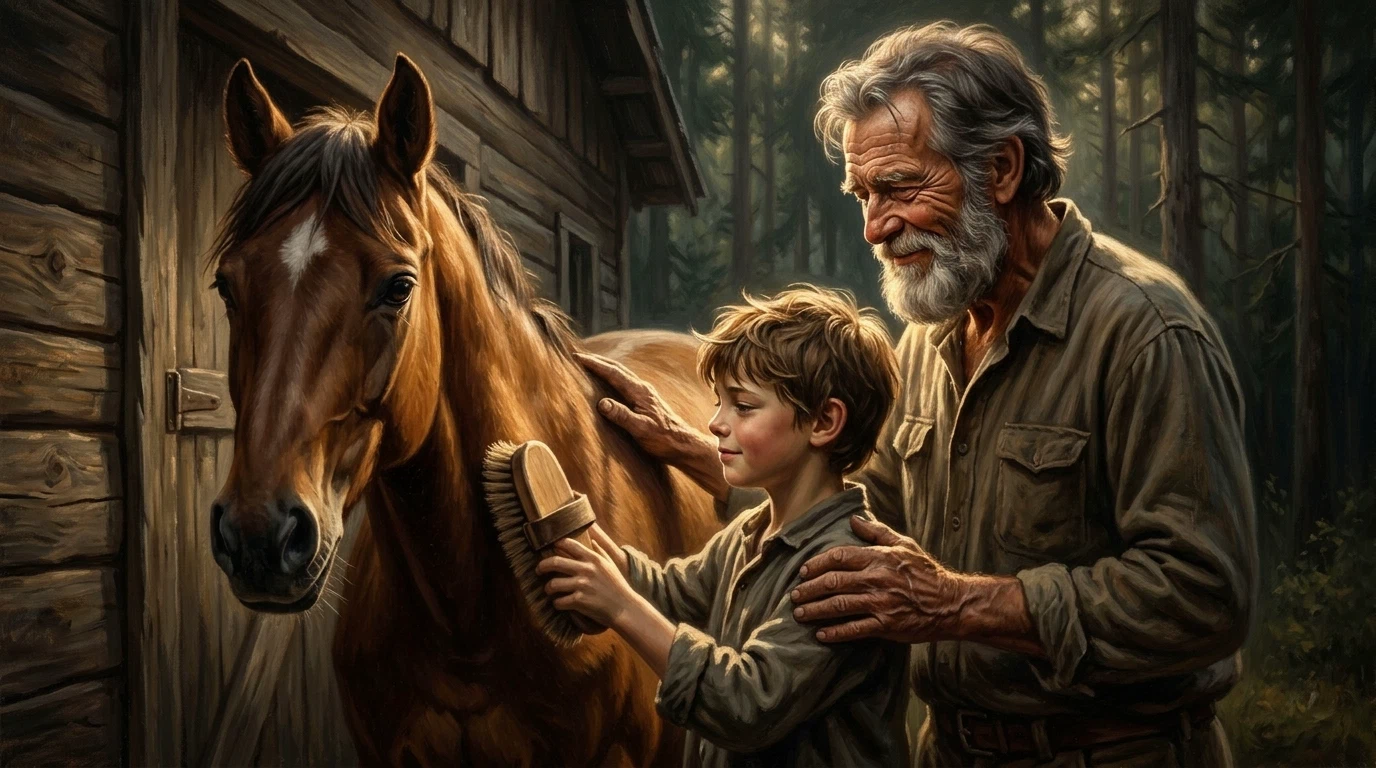
Once upon a time there was a boy in whom a restless fire burned.
In the village, nobody knew what to do with him. He ran too fast, he asked too much, he did not fit on any chair. Wherever he went, he met gazes that kept him small. “Sit up straight,” said the teacher’s eyes. “Pull yourself together,” said the neighbours’ eyes. The more strictly they looked, the more wildly the boy’s heart thrashed about.
One afternoon, when the village became too narrow for him again, he ran all the way up to the last farmstead at the edge of the forest. There an old man lived among his horses, two dogs, and the tall fir trees.
The boy stepped defiantly through the open gate, fists in his pockets, ready for the next bit of mischief – the next “What are you looking for here?”. The old man stood by the wooden well, grooming an old mare. When he turned around, the boy stopped dead in his tracks.
For the old man had eyes unlike any the boy had ever seen in the whole village.
Around them lay deep lines from decades in wind, weather, and forest. Yet there was no resentment in them and no weariness. They were contented eyes – the eyes of someone who no longer had to prove anything to anyone. They were merciful – wide and warm like a summer evening, without any judgment. And yet deep inside them flashed a bright, fiery glow: unbroken vitality, awake like the fire in a warm cabin.
The old man said not a word of instruction. He did not size the boy up from above. He simply looked at him with that calm, sparkling gaze, and wordlessly held out the second brush to him.
And in that second, something strange happened.
For the first time in his life, the boy did not have to defend himself. He did not have to act bigger than he was, nor make himself smaller than he felt. In those contented, merciful, and fiery eyes lay a single silent sentence: You are good as you are. You may simply be.
The fists in his pockets opened. His shoulders dropped. The wild, hunted fluttering in his chest subsided.
He took the brush, stood beside the old man at the horse’s warm flank, and began to stroke calmly. They did not speak a word all afternoon. And yet the boy had never in his life been understood so deeply.
The fire in him kept burning. But it burned calmly, like in a stove.
Only many years later did the boy understand where those eyes came from. The old man had spent his life outdoors, in wind and weather, among the animals. And no tree can be hurried, no animal obeys mere harshness in the long run. Whoever lives with them learns to wait, to understand, and not to break what is wild, but to respect it. All the hardships had made him gentler, not more embittered.
By René Jochum - LLM Translated. License: CC-BY-4.0.