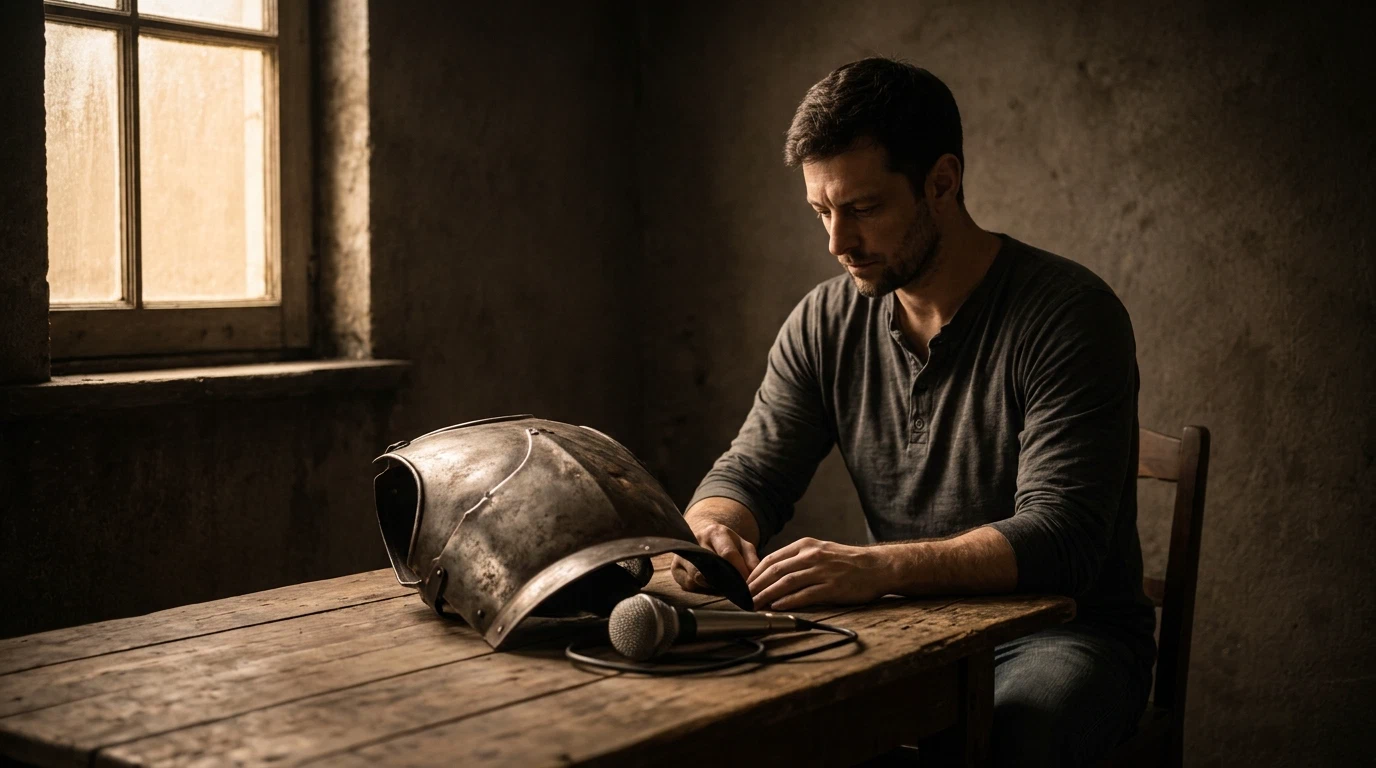
Why we fall silent when life hurts – and what freedom lies in taking off our own armour.
In extreme cases, silence can be life-threatening. It quietly isolates us from the inside out, gnaws at our self-confidence, and in the worst case costs lives.
Why, then, is it still so hard for us to speak up when life hurts? Viewed without blame, our silence is an old suit of armour. Across generations – through wars, poverty, and the hard reconstruction after 1945 – an iron rule of survival applied: pull yourself together and function. Our ancestors had to pack away their pain in order to build the prosperity we enjoy today. Their silence was not coldness, but necessity.
The problem is: many of us simply keep wearing this iron armour in everyday life today. We have internalised the old compulsion to function as shame, smiling through exhaustion and treating our own fractures as a personal flaw.
The “8 Mile” Principle: Holding Out the Microphone
What enormous strength is released when you lay down this armour is shown by no scene better than the final rap battle in the film 8 Mile: Eminem (as B-Rabbit) stands on stage, and before his opponent can even catch a breath, he mercilessly raps out everything himself that could possibly be used against him – his white-trash trailer park, his poverty, his defeats, his own shame. And then he holds the microphone out to his opponent:
“Now tell these people something they don’t know about me.”
His opponent is completely disarmed and cannot get a single word out.
That is exactly what happens when we break our silence: shame loses its power the very second we speak it out loud ourselves. Whoever stands by their fractures can no longer be blackmailed.
The Monster in Your Own Head
How much our own silence sometimes traps us in completely unnecessary shame is something I once experienced myself in an almost comically mundane way:
For quite a long time, I seriously believed that I smelled bad. That thought weighed heavily on me in silence – until I finally plucked up the courage and simply asked my boss directly. His answer was dry and clear: “No, never!”
In a single second, a ghost that had haunted my head for months was simply gone, and today I can laugh about it wholeheartedly. The monster had existed only in my own silence.
When the Stage Is the Wrong Place – and Who Still Needs the Armour
Honesty, however, requires two important caveats that are often overlooked:
- First heal, then rise above it: This sovereign openness à la 8 Mile only works when you truly stand behind your fractures and can honestly smile or laugh at yourself. As long as a wound is still freshly bleeding, the open stage is the wrong place. For suppressed shame to turn into genuine composure, it first needs a protected space on a small scale – honest, benevolent conversations among friends, within the family, or in good therapy. Only once the pain has been held and accepted there does it lose its sting.
- Those fighting for survival need protection: Not everyone can simply take off their armour today. For anyone struggling with fixed-term contracts, barely able to pay rent, or working in an environment that punishes every weakness immediately, “pulling yourself together” is not an inherited relic, but harsh daily reality. Whoever is under existential fire still needs their protective shell. That is why basic social security is not a side issue, but the prerequisite for people being able to be honest without fear in the first place.
What Happens When We Lay Down the Armour
Where we stand securely enough, however, we may dare to take the first step and put our cards on the table:
- Real closeness instead of masks: Only when we honestly show ourselves with our strengths and fractures does true relationship arise – even where people tick completely differently, because honest opposites often attract and complement each other.
- Honest clarity: If, on the other hand, we notice upon opening up that the other person cannot handle it or that the human foundation is missing, it hurts briefly – but saves both sides years of false compromises. You can let each other go with respect and make room for people who are truly good for you.
Silence protected our ancestors, and today it protects those fighting for survival. Yet wherever we can be a safe counterpart for one another, we may lay down the armour.
For the armour secures survival – but only openness gives us real life.
By René Jochum - LLM Translated. License: CC-BY-4.0.