One of the rules I build software by is: constraints outside, freedom inside.
The conditions belong at the edge. What happens inside is then allowed to be direct. No function has to defend itself against its own callers, because what comes in was already decided at the boundary. The boundary is there so that the inside can be free.
With people it turns over.
What the boundary does in code
It says what may cross. Nothing else.
It says nothing about what is inside, how that works, or how it is allowed to change. That is exactly why it holds: it describes a crossing, not a content. What lies inside stays its own business.
What the boundary does to a person
It stops talking about the crossing and starts talking about the content.
That happens because nothing enforces it. A type in code holds itself; it needs nobody to carry it. A boundary around a person has none of that. It has to be carried, and the only way a person carries a boundary is by making it part of themselves.
“I cannot promise that” is a statement about a crossing. True, checkable, bounded. “I am not somebody who can do that” is a statement about what is inside — and it cannot be checked any more, because it has no edge to measure it against.
The way from the first sentence to the second takes half a sentence.
Where these boundaries come from
Hardly anybody draws their own.
They come from outside, often kindly packaged, often well meant. At some point nobody has to say them any more, because you hold them yourself. That is the moment they go hard: a boundary that comes from outside can be negotiated. One you hold yourself is not negotiated, because it no longer feels like a boundary. It feels like a fact about you.
The difference that matters
A real limitation is specific and it has an edge.
I cannot promise reliability across years. That is true, it is named precisely, and it leaves open everything that does not depend on it. It also says what would have to be done: a structure that does not hang on a single person.
The wide version says none of that. It says “I am not one of those”, and what follows from it is not a task but a renunciation. It is comfortable, because you never have to look at it again.
Where this becomes politics
That exact difference is being made policy right now.
The “healthy slap” does not say what may not cross. It tells a child what it is: something you hit. I have written about that before, and the adjective is the whole trick — it turns violence into a boundary that is supposedly good for you.
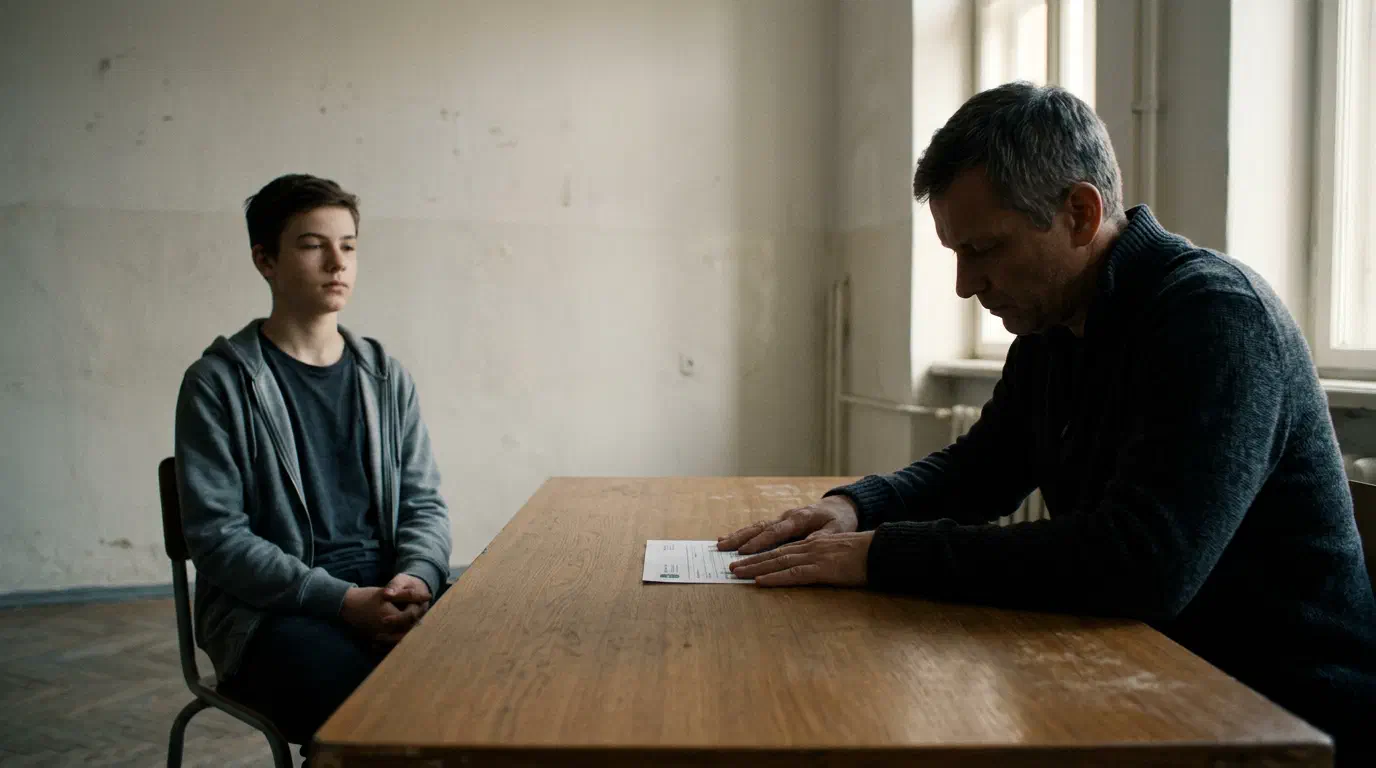
Criminal responsibility at fourteen is the same move with better manners. Formally it is the opposite of one: a limit attached to an act rather than to a person. Except it does not stay that. The record follows the human being, the category sticks to them instead of to what they did, and “offender” is a noun.
A punishment describes an act. A category describes a person. Somebody made criminally responsible at fourteen gets both, and the second one they carry onward, long after the matter is over.
That does not settle the question of boundaries for children. A fourteen-year-old needs them, and some of them have to be enforced. The difference is whether they say what is not allowed, or what somebody is.
Both are drawn from outside and held from inside afterwards. That is the part that stays.
The same goes for an administration that presses every case into a form. What dies in that is first the freedom, then the inner life, and probably people too. I write probably because I cannot prove it, and I am leaving it in anyway.
Why the inner life dies
Because a boundary drawn around a person does not protect what is inside. It replaces it.
In code the boundary protects the free space behind it. With a person the boundary becomes the description — and a description held as a fact stops being tested. You can still change. It just has to happen against the description rather than through it, and that is a great deal more work.
What I do with it
Leave the narrow statement standing and strike the wide one.
Not out of optimism. Because only the narrow one describes something that can be checked, and only from it does a question follow that can be answered: what would be needed for it to work anyway?
The wide statement leaves no question. That is its entire purpose.
Where healing starts
Not with the boundary disappearing. A real limitation stays, and it should.
It starts where the sentence gets its edge back. “I am not one of those” becomes “I cannot promise that”, and there is a question in the room again: what would be needed for it to work anyway? As long as a question is left, something is open.
With yourself that is small. Notice which of the two sentences you just said. At the beginning it is not more than that.
With the next person it is harder, because it means giving something up. Handing out no descriptions. Saying what you saw, and not what somebody is. A description comes from above. A boundary is said from beside, at eye level.
And nearly everybody holding a description of themselves got it from somebody. Not being that somebody is a thing you can actually do.
What heals
I have no recipe for it.
What I have seen: the opposite of a hard boundary is not a missing boundary. It is one that may be talked about. Together, in the open, and with room to own a mistake before it turns into a description.
Punishment and bureaucracy do exactly the reverse. They turn the mistake into a property, and they make hiding it the reasonable thing to do. Whoever hides does not heal. They only administer what has to stay hidden.
A sick society that holds together carries more healing in it than a healthy one that does not. I mean places where everybody has something and nobody gets described for it.
That is not a theory of mine. After the first war the guilt was assigned to a whole people - not a limit on an act, a description for everybody. After the second one they rebuilt and included instead of describing. What came of each I do not have to spell out here.
We have seen it more than twice.
By René Jochum - LLM Assisted. License: CC-BY-4.0.