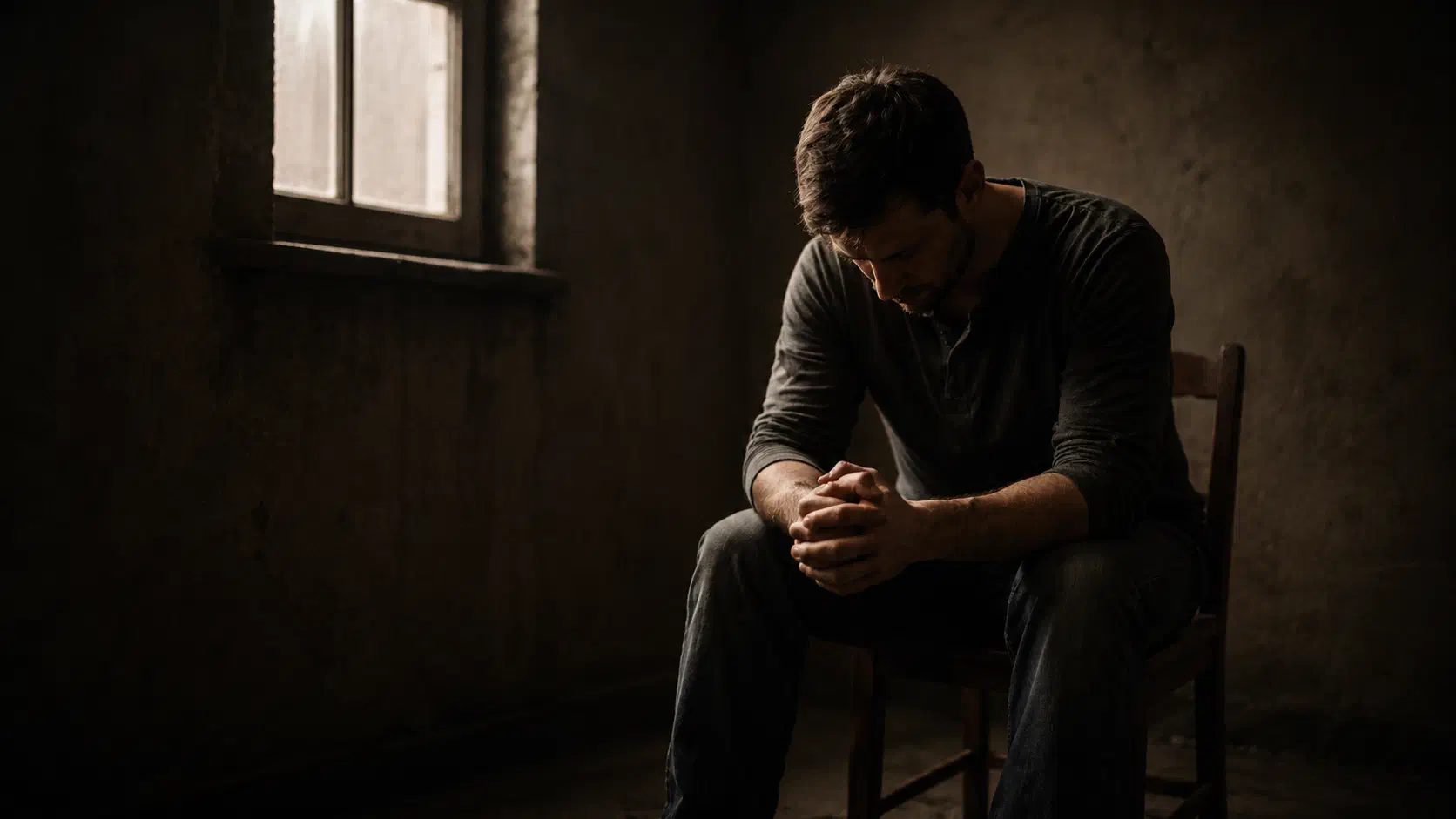
I think of a fictional person.
He is a pacifist — not because he read about it, but because he has experienced violence and rejects it. He comes from a country where men must be strong and are not permitted to show shame. He flees. He arrives here.
He carries something with him. The conviction that peace is possible if someone starts it. He wanted to contribute here. Not as a gesture — because he knows what happens when no one does. He has seen where hate leads. He wanted to live the opposite.
But he is not allowed to. Or cannot. Or both.
The nervous system that survived is not switched off. It is hyperreactive. A loud word, an encounter with a government authority — and the body responds before the conscience can catch up. Research calls this a lowered aggression threshold after trauma. It is neurobiologically real, not a moral failure.
Afterward he sits alone in his apartment and looks at his hands. As if they belong to someone else. He washes them, even though they are clean. Then he prays — not out of piety, but because prayer is the only language in which he can say: that was not me. Not the person I want to be.
This fictional person is alone. Back home there were multi-generational households — family across generations that carries, regulates, holds. That framework is gone here. What would have caught him before no longer exists.
Then there is the outside world. A skin color, a religious conviction — and he is read as a terrorist. I know that look. People address me about my religious convictions in the same way sometimes. “Are you a terrorist?”
Recently I met someone. I told him I respected his faith. His first reaction was not joy. He explained to me that he is not a terrorist. He explained what Islam means: peace. That a Muslim is one who surrenders to peace. He had to justify himself before I had even asked him a question. Because the world asks him that question before it listens to him.
Whoever experiences this constantly, internalizes it. Or breaks under it.
Imagine being asked, directly or indirectly, every single day whether you are a terrorist. How long would you feel like making peace?
This fictional person stays silent. In his culture he is not allowed to be weak. Strength there means: endure without complaining. Accepting help would confirm exactly the weakness his culture warns him against. The longer he stays silent, the more what he cannot speak aloud intensifies.
To understand the mechanism, a second fictional example helps. Imagine someone who cannot cope with themselves and has no language for it. Who at some point turns to sex workers — not out of desire, but because the body takes what the mind will not allow. At some point there is a turning point. Not because the shame disappears, but because people stay who endured him until he could walk himself.
For the fictional refugee, that turning point does not exist. No people who stay. No safety, no language, no brake.
Then something happens. An incident. And the headline finishes him off — and many others along with him: Refugee, violent.
No one writes what came before. No one writes what he might have needed.
I wonder whether we could give him the language in which he can help himself. Whether there is a form of help that does not insult his strength. That does not presuppose he sees himself as a victim. It already exists — AFYA is one example.
He wanted to contribute. The question is whether we leave him the ground to do so.
Listen before judging. Don’t look away when someone sits alone with their hands. And for those who want to help concretely: AFYA does exactly this work — a donation makes more of it possible.
By René Jochum - LLM Assisted. License: CC-BY-4.0.