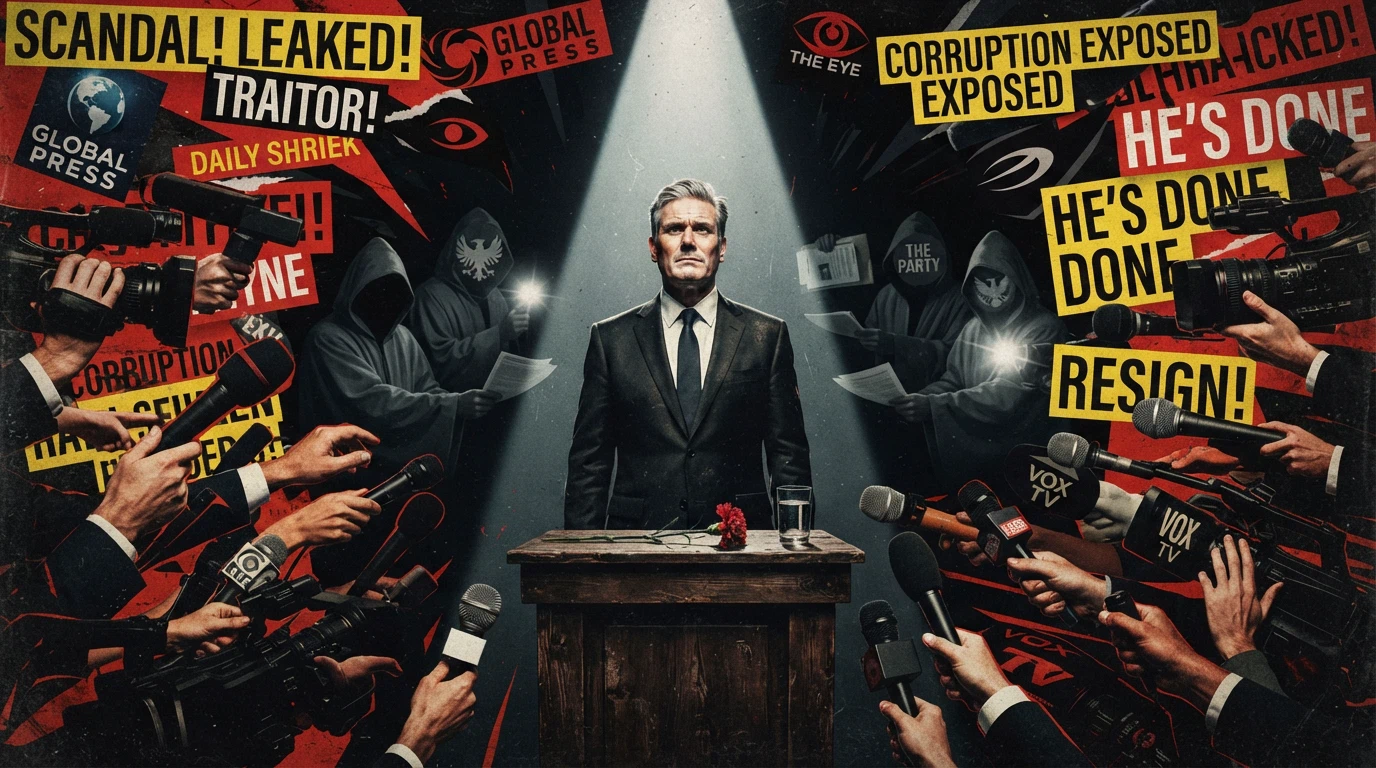
I make no secret of it: I am a grassroots member of the Social Democratic Party (SPÖ) – heart and soul. At least until there is a new, better system. I sit in no circle of party officials and eye no positions. I stand at the grassroots, where people still believe in the movement’s core values: in genuine solidarity, social justice, and standing together honestly.
That is precisely why what has unfolded in Austria over recent months hurts twice as much.
In the current issue of DIE ZEIT (No. 51/2026, November 26, 2026), Florian Gasser vividly describes how the Austrian tabloid press treats Andreas Babler. The article raises a question that should alarm every citizen – regardless of where they cast their vote: Who actually governs this country? The elected representatives of the people, or the executive suites of powerful tabloid media companies?
The Taboo of Money: Public Funds for Favorable Coverage
Political mistakes can and must be relentlessly criticized. That applies to every party, and of course it applies to Andreas Babler as well. Criticism of tactical blunders, political communication, or policy stances is the lifeblood of a working democracy.
Yet what is at the core here is something entirely different: Babler touched the greatest, most fiercely guarded taboo of Austrian domestic politics – the allocation of government advertising funds.
Austria has indulged in a unique dynamic for decades: the federal government, provinces, and state-affiliated enterprises pump over 200 million euros of public funds annually into government advertisements and media deals – many times the regular, quality-linked press subsidies. Anyone attempting to reform this system and tie it to transparent, objective criteria reaches directly into the balance sheets of powerful media conglomerates. And the system strikes back with full force.
How independent can coverage truly be when the very papers that sit in daily judgment over politicians simultaneously depend financially on those politicians’ budget decisions?
What Any Street Gang Understands Better Than a Party Apparatus
Every gang on the street, every crew at the skate park, and every circle of friends on the asphalt shares an unwritten code of honor: We stick together.
That doesn’t mean mistakes are swept under the rug – quite the opposite. When someone in the crew messes up or loses their way, you pull them aside. You speak plain truth behind closed doors – as hard, direct, and blunt as it needs to be. But outwardly, in front of the world, you hold up the shield. You don’t stab your friend in the back before strangers.
I recently wrote a song about this very lesson for my album Männer: “Loyalty”. In it, I tell a mundane story from my own life: how I once humiliated a good friend in front of everyone over a piece of bread from the fridge – and how he taught me behind closed doors what real greatness and loyalty actually mean:
“Under four eyes, speak to me as harshly as you must –
but never crush your brother’s chest before the crowd in dust!
That’s how you let a friend stand tall when down upon their knee:
you hold your shield before their name where all the world can see!”
Back then, I had to swallow my pride, step up in front of everyone, and play the fool myself so that my friend could keep his dignity.
And what happens inside our own movement?
When intra-party rivals feed the tabloids with anonymous leaks and calculated digs to undercut their own leader, basic decency goes out the window. Instead of hashing out differences internally and on eye level, the press is called to position themselves in the slipstream of their own careers.
On political talk shows, this is politely termed “internal party friction.” On the street, it is simply called cowardice and betrayal. Anyone who carries the word “comrade” on their lips while running to the tabloids at the first opportunity to tear down their own people mocks the very concept of solidarity.
The Attack on a Father
What we have witnessed in recent months was no longer tough journalistic scrutiny. It was mockery, spite, and systematic personal wear-down.
What hurt me personally the most – and where every boundary of human decency was shattered – was the attack on his father.
A shift worker who spent his entire life working hard. That people don’t even stop at an old father’s medical history, driving a son to release doctors from confidentiality just to defend his father’s memory against defamation – that sinks to an unprecedented low.
In the Ten Words of Freedom, the fifth word states: Give weight to your roots, to your father and your mother (Kabed). Our parents and ancestors are the ground on which we stand. And my personal 11th commandment exists for a reason: Protect the private sanctuary. Whoever weaponizes a father to strike at a son politically tramples on basic human decency. Someone’s roots and family do not belong on the tabloid pillory. Period.
Who Will Want to Do This in the Future?
Press freedom is an indispensable, precious pillar of democracy. But press freedom exempts no one from journalistic diligence and basic decency.
The crucial question we must ask ourselves is:
What honest person with a heart, a mind, and a family will still be willing to take on political responsibility in this country in the future?
If the price of entry is that your family becomes a target and publishers decide who survives politically, only two kinds of people will remain: ruthless power-seekers with teflon skin who feel no shame – or cynical tacticians who play the dirty game themselves.
People who burn with genuine conviction for the public will be driven out of politics. And that is the greatest damage that could possibly be done to our republic.
A politician must answer for their mistakes. But they must not lose their human dignity or the safety of their family in the process.
By René Jochum - LLM Translated. License: CC-BY-4.0.