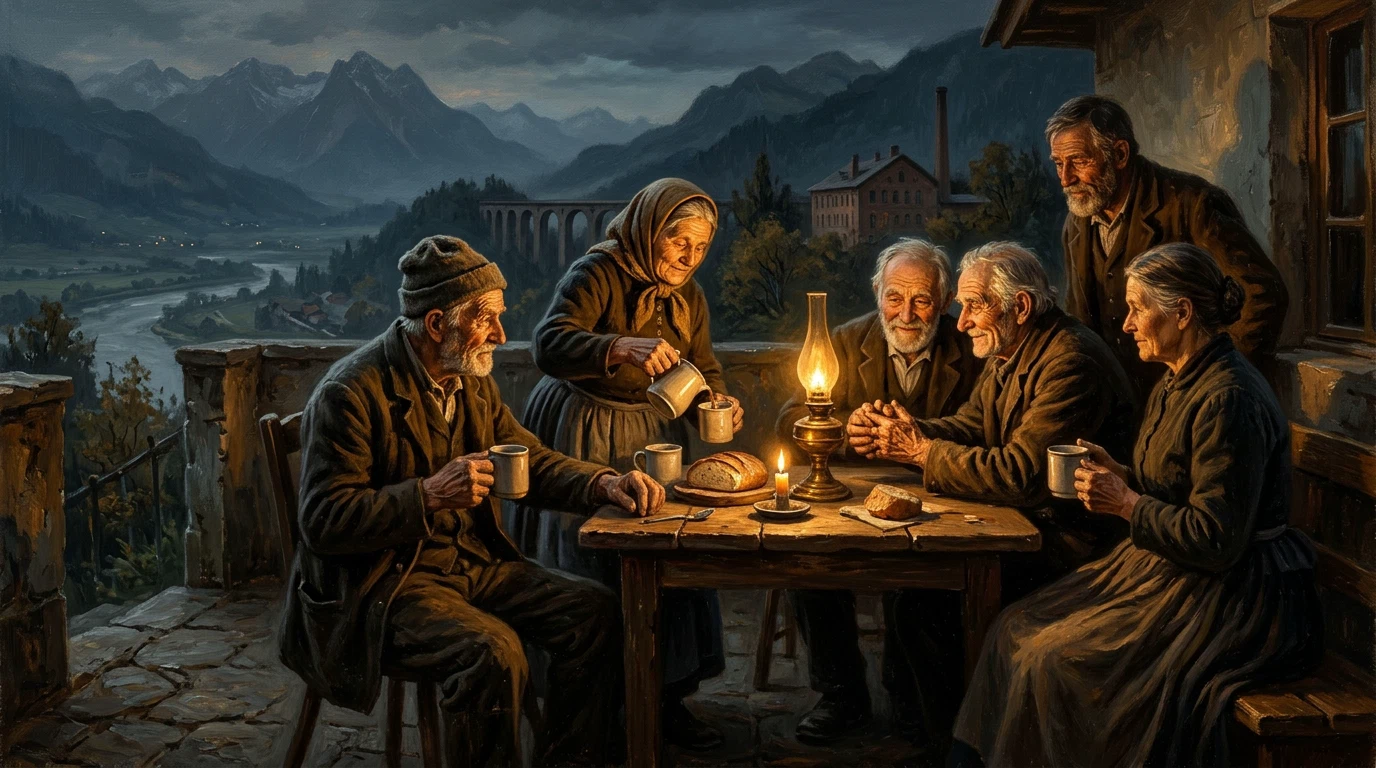
For a long time, Vorarlberg was a bitterly poor land. A land that had to send its own children on foot over the mountains into foreign parts as Schwabenkinder (Swabian children) because there was not enough at home to feed everyone.
Today we look at clean municipalities, strong businesses in the Rhine Valley and Walgau, hydroelectric power plants in the mountains, and a prosperity that many envy us for. And we often act as if all of that had grown out of the ground all by itself — solely through our own diligence.
That the poor land behind the Arlberg became today’s Vorarlberg is something we also owe to those who came to us when we needed hands. And for whom we often made things anything but easy in the beginning.
Thank you to the “Wälschen” from Trentino, who came over the mountains as early as the late 19th century. You helped build the Arlberg railway, tamed our mountain torrents, and stood in the first large textile factories in Bludenz, Feldkirch, and Dornbirn. You were put into separate settlements and looked at askance for decades — today, thousands of proud Vorarlberg families bear your names.
Thank you to the Styrians and Carinthians, who left their homeland after the war to toil on the great dams of the Illwerke in the Montafon or to stand at the looms and machines in the Rhine Valley. You slept in barracks, switched dialects, swallowed your homesickness, and helped build this land stone by stone.
Thank you to the first generation of “Gastarbeiter” (guest workers) from Turkey and the former Yugoslavia. You were called in the 1960s and 1970s because the machines at Hämmerle, Getzner, Benger, or Zumtobel would have stood still without you. You were called “guests,” even though you stayed for an entire working life. You sweated in shift work, did the hardest and dirtiest jobs, lived in the old apartments nobody else wanted, and turned every schilling over twice so that your children would have it better one day. You stayed silent when people talked about “the foreigners” at the regulars’ table — and stood back at the machine at five o’clock the next morning.
None of you came empty-handed. You put your strength, your health, your youth, and your patience into this soil.
And we? We took your contribution for granted and made you feel as though you ought to be grateful that you were allowed to work here. That was the wrong way around.
Today we turn it around:
We say thank you to you. Thank you for your work. Thank you for your patience with our often brusque manner. Thank you for staying and making this land your and our shared home. Without you, Vorarlberg would not be what it is today.
Federal President Alexander Van der Bellen summed it up a few days ago in his speech on the National Holiday: Austria has always been a place of encounter where the most diverse languages, dialects, and roots met. When we look honestly into our own family histories, we see: this country did not grow strong through isolation or by dividing people into “valuable” and “worthless,” but through the willingness to take the first step toward one another, to find good compromises, and to recognize ourselves in the other.
This thank you therefore does not end as a look back. From it follows a standard for today and tomorrow: let us not be talked into believing that only certain people are the “true people.” It does not matter where someone comes from, whom they love, what they believe in, or what their last name sounds like. Whoever respects this country, shares our rules and fundamental rights, and becomes part of our community is not a guest. They belong to us. Because the people — that is already all of us.
Uf a nand luaga — looking out for one another, yesterday, today, and tomorrow.
I am no speaker and I am not looking for a stage. This is my personal draft for a public thank you — grown out of the idea of Uf a nand luaga and encouraged by the words of our Federal President on the 2026 National Holiday. Whoever has a voice in politics, in a municipality, in a company, or in a local club and can use these words: take them. That is why they are here.
By René Jochum - LLM Translated. A free draft for anyone who wants to give it a voice. License: CC-BY-4.0.