Honest note upfront: I do not live in the United States and, quite honestly, have no idea what everyday life on the ground truly feels like there. This text is purely an observation from afar – prompted by media images that stayed with me – and above all a reflection on why our social peace here at home is so precious.
At the White House Correspondents’ Dinner in Washington, an elderly gentleman sat upright and calmly ate his burrata. Outside, gunshots; inside, panic. He stayed seated. Bad back, he said dryly afterwards. New tuxedo, dirty floor.
At first glance, that reads almost nonchalant. Yet behind it lies a bitter image of a society that has grown used to a state of emergency.
“Thousands from the country’s journalistic and political elite have now gone through what countless other Americans have had to experience in their schools, offices, shopping malls, and churches.”
— Brian Stelter, CNN
What Constant Fear Does to a Country
Where basic trust between people breaks down, a silent chain reaction sets in:
More insecurity → more isolation → less trust → less lived democracy.
After September 11, 2001, came the Patriot Act, surveillance programmes, and emergency laws that were never fully rolled back. Not because a single evil plan stood behind it, but because permanent fear does precisely that: it forces people into survival mode and creates hard structures that stay.
In the US, hundreds of gun violence incidents a year have become part of statistical everyday life – in schools, supermarkets, neighbourhoods. When the top of the state is affected, the apparatus reacts immediately. When it hits the everyday life of ordinary people, it often remains at rituals of dismay. That is not a conspiracy, but a shifted priority.
When Two Halves No Longer Sit in the Same Boat
The real warning sign in the US today is no longer the classic argument between left and right. Contradiction and tough debates belong to every living democracy.
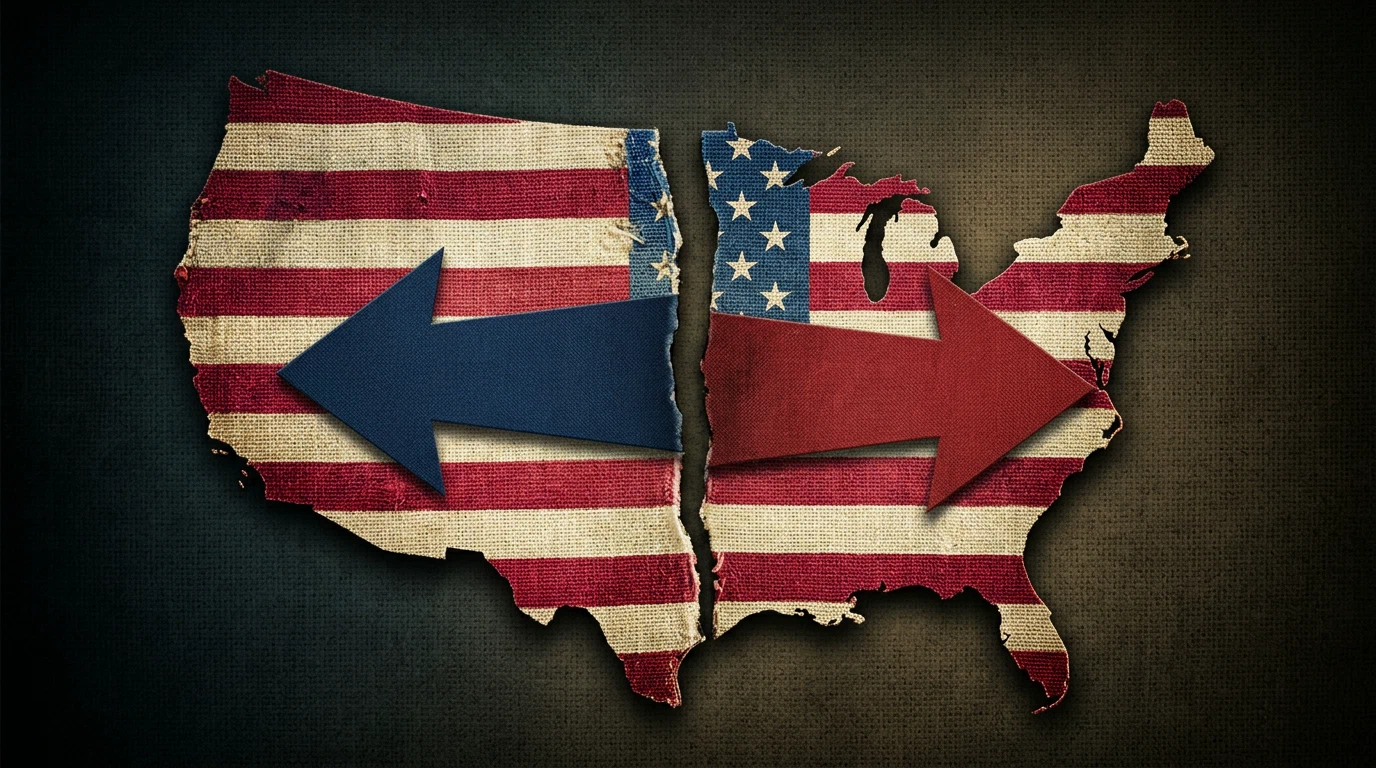
It becomes dangerous where two halves of a country no longer touch at all – where people no longer sit at one table, but live in two separate realities:
- Speechlessness instead of compromise: Each side has its arguments, its own media, and its own bogeymen, but hardly anyone looks for a shared solution anymore.
- Exhaustion from below: When a society is so deeply divided, democracy rarely dies through a loud coup from above. It loses quietly from below – through exhaustion. When people in everyday life lose the feeling that their voice counts and that people are there for one another, they withdraw. They stop voting, they stop getting involved, they look away.
What We Can Learn from This for Ourselves
America has strong institutions, states, and courts that repeatedly push back. Yet no law book and no constitutional court can carry a country alone if the human foundation underneath erodes.
For us in Austria and Europe, there is a simple but urgent lesson in this:
Social peace, safe schools, and the feeling that you can walk through your own municipality at night without fear cannot be taken for granted. They do not arise through even more harshness, nor through division, but by looking out for one another in time (“uf a nand luaga”) – making sure nobody falls through the net before despair turns into violence or powerlessness turns into indifference.
Institutions only hold for as long as enough people act in everyday life as though we belong together.
By René Jochum - LLM Translated. License: CC-BY-4.0.