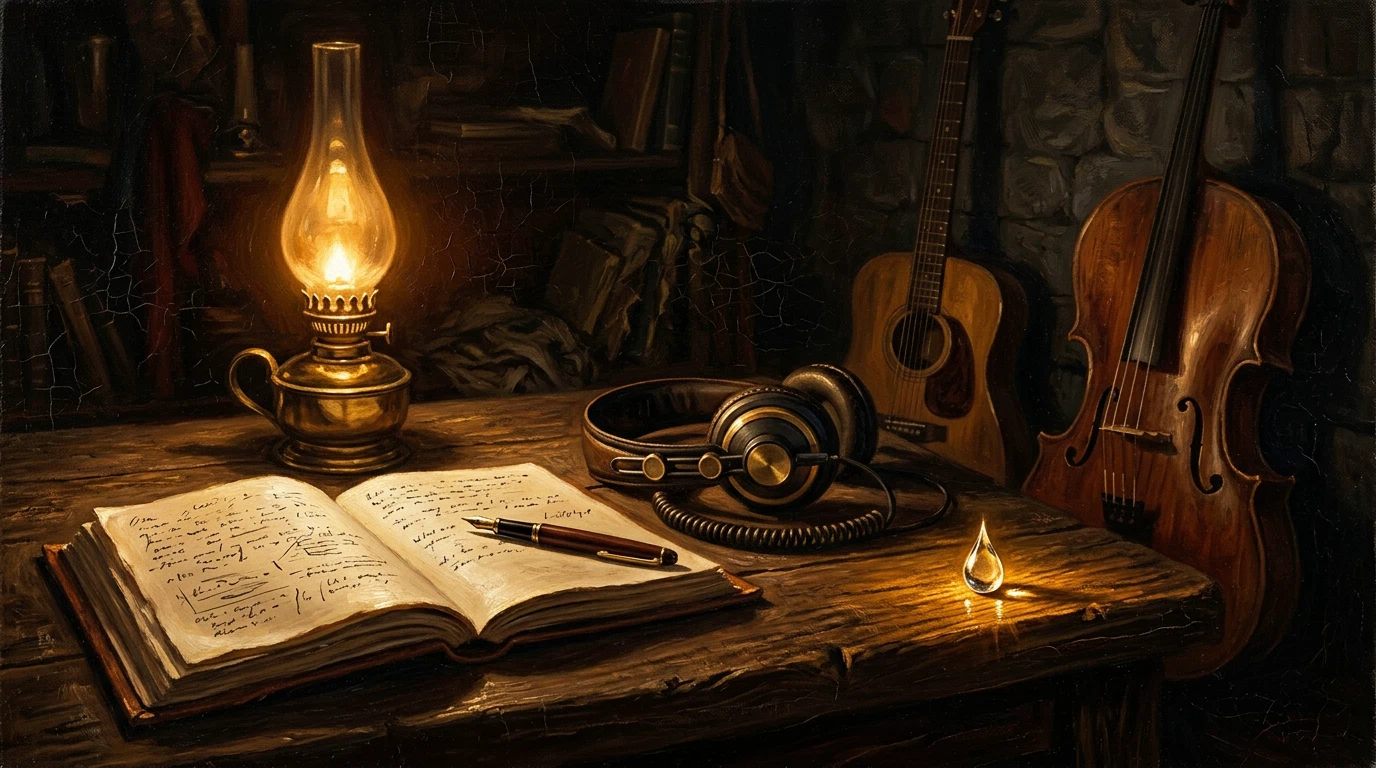
I will put my cards on the table right from the start: I cannot sing, I do not play the cello, and whenever I pick up a guitar myself, it is at best enough to send the neighbors running.
Even so, over the past few weeks I have made two complete music albums. And I have no intention of pretending there is a real band standing in my basement. The lyrics are crafted in close back-and-forth dialogue with language models; the music and vocals are generated as well.
Why do I do it? Quite simply: because I have no better way to bring my thoughts, my stories, and my kind of art to people.
Not everyone likes reading long texts on a blog; sometimes your head is too full after a workday for written paragraphs, whereas a song in the car, in the workshop, or late at night on headphones still gets through. Yet for me, this is not about pushing a button and letting a machine invent smooth, artificial feelings. No artificial intelligence in the world comes up on its own with my grandma’s “Zfrieda muss ma si” (“You have to be content”). No machine knows what a closed psychiatric ward feels like from the inside, what it means to pull a rusted bucket out of the lake as the black sheep of the family, how warm the merciful gaze of the first generation of guest workers was — or what it looks like to stand in the bathroom in the morning blow-drying your own backside because you don’t own a tumble dryer.
The raw material is one hundred percent my lived life, with all my shadows, failings, and insights. I throw my real experiences and thoughts into the ring, wrestle with the rhymes sentence by sentence in dialogue until there is no false word and no high horse left in them, and in the end let the AI do what I cannot do myself: give the whole thing a voice, a piano, a frame drum, or a wall of guitars. For me, this technology is simply a walking aid — like an amplifier for someone who cannot bring out a note on their own.
What surprised me the most, however, only happened once the finished songs played through my speakers.
I sat in front of my screen and wept like a child.
When you write a text down just for yourself, it always stays inside your own head and in your own silent voice. But when a rough, unfamiliar male voice over a piano and cello suddenly sang about my own nocturnal room where I tame my ego (“Die Stille”), it hit me from the outside straight in the chest. It was the same with the late love letter to my mother (“Danke, Mama”), with “Auf den Knien” (“On My Knees”) — that feeling of standing shoulder to shoulder with brothers in prayer, sheltered as if in a mother’s womb — and out of laughter and deep emotion all at once with “Abdest kaputt”, a small, true anecdote among brothers at the mosque.
Long before any other human being heard a single note of them, these songs were a piece of real therapy and recovery for me.
Out of this work grew two albums that belong closely together:
The first is called “Uf a nand luaga” (Looking out for one another). It tells of the road out of the dark hole back into life — of the two wolves inside one’s own chest, of fools who recognize one another, of primal trust in prayer, and of a late “May God reward you” to my family, to civil-service workers, and to the people who helped build this country.
The second album is called “Die Waffen des Pazifisten” (The Weapons of the Pacifist). It clears up the misconception that a peaceful person is defenseless. Across fourteen songs, it explores the inner and outer armor needed to walk upright through this world without violence: from the open gaze into another’s heart and the “other door” in one’s eyes, through silence, tears, prayer on one’s knees, and a reliable word, all the way to the ability at the very end to laugh wholeheartedly at yourself.
It is music from a machine, yes. But the heart, the scars, and the tears inside it are real. If even a single song from it shows someone in the dark that they are not alone in their struggles, every line was worth it.
I still cannot sing. But I am no longer mute.
By René Jochum - LLM Translated. License: CC-BY-4.0.