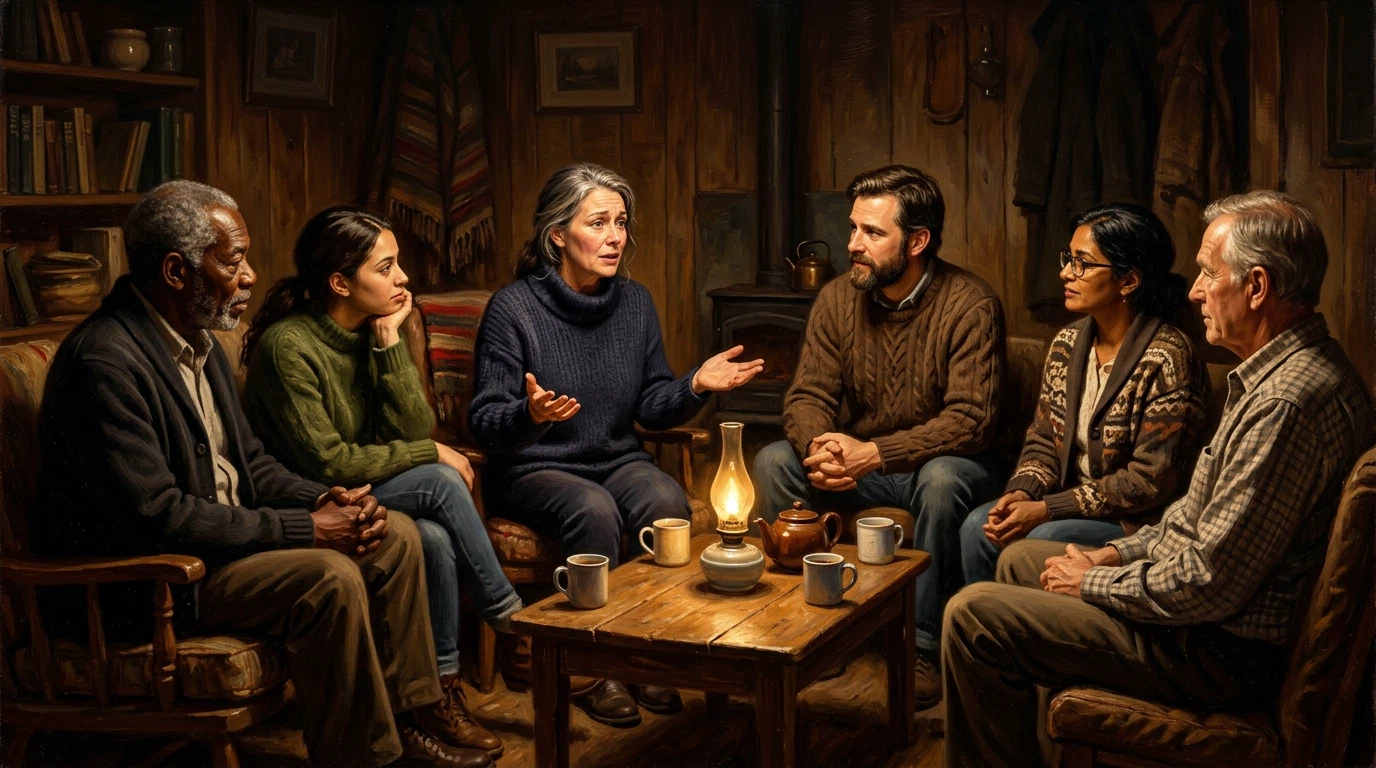
Most people picture a support group as a place for an absolute emergency — and only go when nothing else works anymore.
My experience with my bipolar disorder is different: You should attend a support group in all walks of life — except during acute crises.
A group is no substitute for therapy. And anyone in the middle of an acute crisis needs rest, protection, and professional help — a doctor, a crisis service, or a clinic. A group is the wrong place then. Both for yourself and for the others in the room.
The real value of a group lies in all the days in between. When things are going well, when they are going so-so, or when they are just beginning to wobble slightly.
“We-Knowledge”
As long as you sit alone at home with your diagnosis, everything revolves around your own self. You are stuck inside yourself.
In the group, something emerges that no textbook alone can provide: “We-knowledge” (Wir-Wissen) — a core building block among peers, the experiential knowledge grown from shared paths. What used to be only deep “inside me” becomes “ours.”
I no longer see only my own struggle; I get to know the suffering and, above all, the coping of others. Everyone in the room has been out there themselves. Out of all these individual paths grows a shared treasure of experience on which everyone stands more securely.
The Right Balance
How I contribute to the group always depends on my own state of mind on that day. It takes a fine sense for the measure in the room: not talking too much, not talking too little — and on some days, simply being allowed to listen. As a chatterbox myself, I often enough have to keep myself in check there.
Neither exaggerating nor understating: neither making your own suffering bigger than it is, nor talking it down out of false shame. Hurting no one while at the same time keeping your own boundaries.
When It Tips
You can feel very quickly when a group loses its value: when it becomes restless.
A good group lives from confidentiality and a certain underlying calm. From a space where you are allowed to be, without individuals flooding the entire evening, people winding each other up, or forcing unsolicited solutions onto one another.
When that calm holds, you almost always walk home lighter after such an evening than when you arrived. Not because all problems have been solved. But because what was locked “inside me” has become “ours” again.
By René Jochum - LLM Translated. License: CC-BY-4.0.