If you like, listen while reading:
Once upon a time, there was a boy who grew up in a house where the light rarely reached the floor.
His hands were still small, yet they already knew how to tremble. His back was still soft, yet he already knew how to hunch when the footsteps outside the door grew heavy. And worse than the blows that could be seen were the sentences that stayed behind. They did not draw a boundary around what he did — they described what he supposedly was: too loud, too little, wrong.
For a long time, the boy believed those sentences. Whoever grows up in the dark eventually mistakes the darkness for the normal color of the world.
As he grew older and his shoulders broader, he noticed one day that the old coldness had crept into his own hands. He felt the pressure in his chest — the urge to become hard himself and pass on what had been done to him.
Then he stopped. For the first time, he did not duck his head, nor did he raise his fist.
He stood upright. Piece by piece, he grew a backbone made not of iron, but of a quiet decision: This far and no further. It ends with me.
The hardest road only began after that. He had to learn to forgive himself. He forgave the child he had been for not being able to defend himself. He forgave himself for the years in which he had believed the dark voices, and for the anger he had carried around like a heavy stone for so long.
Only many years later, long after the storm inside him had passed, something happened that he had neither sought nor planned: one day he realized that even the resentment toward those who had once bent him had vanished. Not because what had happened was suddenly good. But because the old burden simply no longer belonged to him. He set it down and walked on.
The boy became a man to whom people came when they no longer knew where else to turn.
His difficult beginning had become the very thing with which he could stand by others. When a storm gathered over the village or life tore the ground from beneath someone’s feet, the others panicked because their light went out. He, however, remained calm. The darkness no longer frightened him. He knew his way around it. He knew how to feel for the path in the dark.
One day, a man returned to the village who had committed a grave mistake years ago and had served his sentence down to the very last day.
For the village, the man was still not free. Wherever he walked, conversations fell silent. People did not see a human being; they saw only the old deed. They pushed him to the margins, out where no one wanted to look.
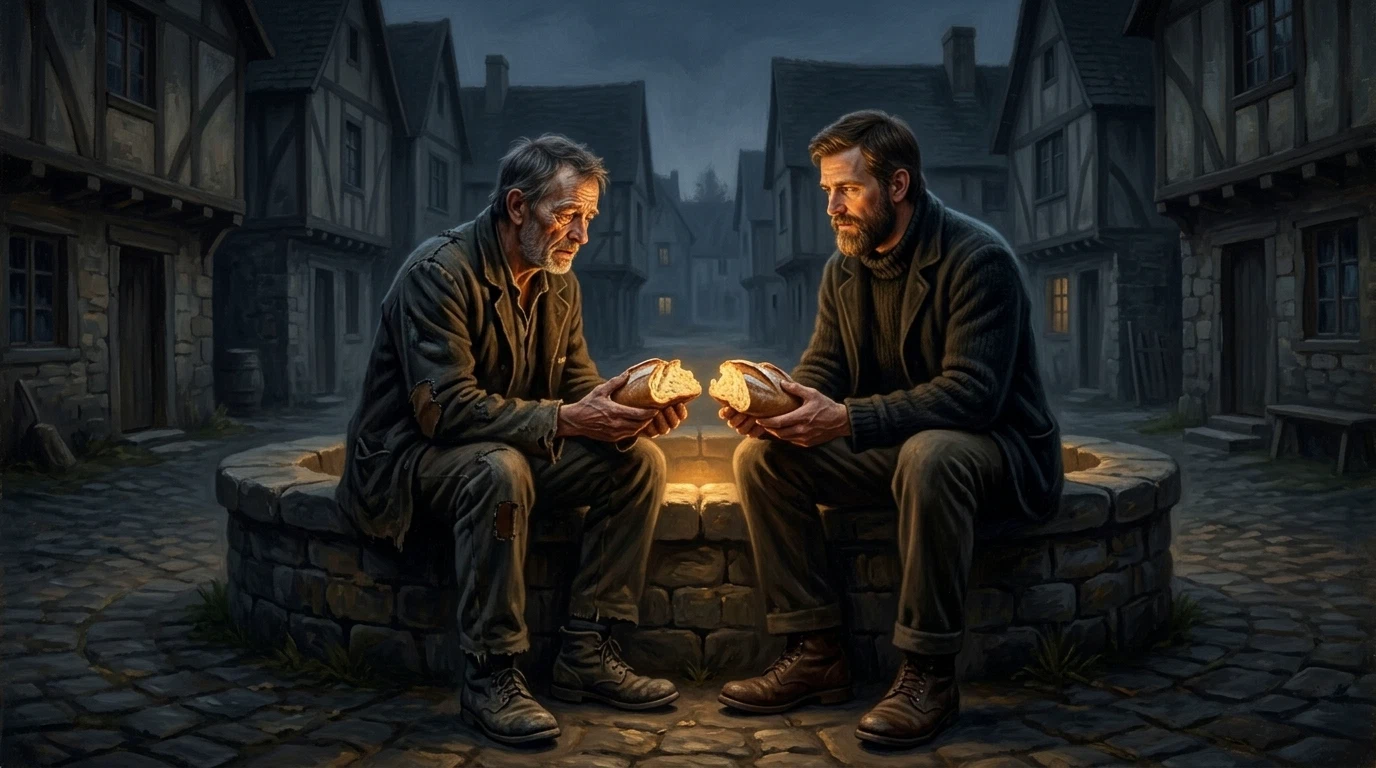
When the returnee sat alone by the well in the evening, his gaze fixed on the ground, his back bent under the eyes of the others, the man who had once been the boy walked up to him.
He kept no distance. He simply sat down beside him on the cold stone, took a piece of bread from his pocket, broke it in two, and held out half to him.
The returnee looked at him suspiciously. “Don’t you know what I did?” he asked roughly.
“You have paid,” the other said quietly.
The stranger stared for a long time at the bread in his hand. Then his shoulders dropped a little — the way they only do when someone, after a very long time, is looked at as a human being again for the first time.
They ate in silence side by side while dusk fell over the village. For the others, it grew dark. For the two by the well, it was bright enough.
By René Jochum - LLM Translated. License: CC-BY-4.0.