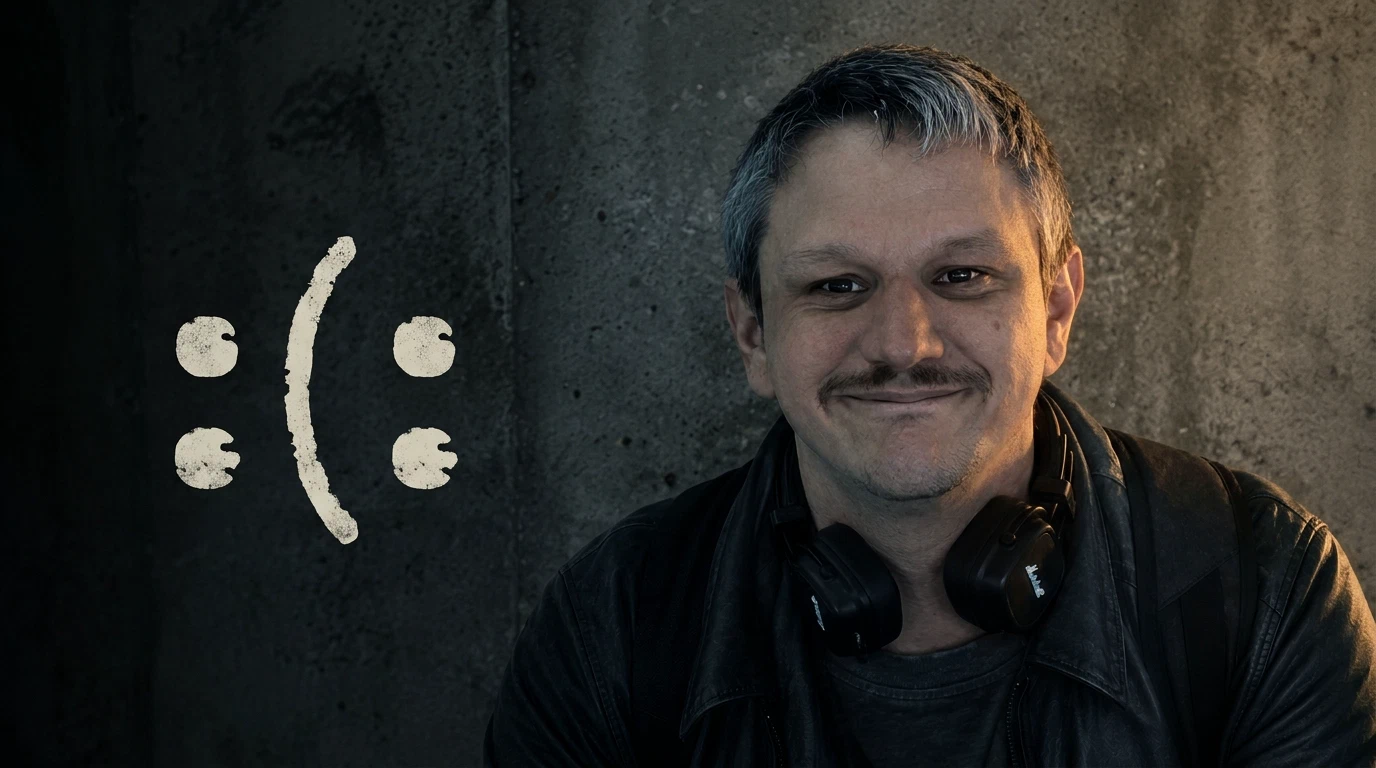
To many people, “bipolar” sounds like a mere swing between good and bad moods. On paper, however, my diagnosis reads Bipolar 1 with psychotic symptoms – and when I am in full-blown mania, it has nothing whatsoever to do with “being in a good mood.”
It often starts constructively: I have countless ideas, mostly driven by an honest desire to improve things fundamentally. Yet my head shifts into a speed that hardly anyone on the outside can follow anymore. There is no longer any filter between thinking and speaking – almost every thought has to come out the exact second it arises. At the same time, my short-term memory collapses: what I said days ago, or even just a few moments ago, is erased almost in the same instant. Only this hyper-accelerated Now exists.
The further this state builds up, the more reason takes its leave – and the narrower my field of vision gradually becomes. That has nothing to do with classic selfishness, but with an ever denser tunnel vision: the stronger the mania gets, the more everything revolves around my own perception, until at some point my inner world is the only world I still register. And when this state tips into psychosis at the highest stage, the brain places one final interpretation on top: the honest wish to see through everything and make it better turns into the firm conviction of being a chosen one.
How Does This State End? There Is No Simple Off Switch.
For me to come back down, I first have to understand for myself that I am manic at all – and in a state of emergency, that is extremely hard. As long as everything feels coherent inside your head, there is simply no reason to hit the brakes.
What flips that switch is different every time. Sometimes it happens when I come across something on the outside that suddenly makes me find myself completely goofy – like looking at the “Lochgott” cartoon in Der Standard. Another time, some circumstance suddenly makes it dawn on me that I have just royally messed up.
And then there is a third, deeper trigger: a vast, existential fear that suddenly breaks through the mania – the naked fear of “being a mistake” myself. Not just of having done something wrong, but of being wrong at the core. As painful as that fear is in the moment, it brings the over-revved system down from the throne of the “chosen one” and acts like an emergency brake. It brings me back down to earth far enough to walk into the nearby psychiatric clinic (which, thankfully, is getting noticeably better from year to year).
The Pendulum Swing in the Other Direction
Shortly after the mania subsides, my system tips into the other extreme: depression. At first, this low still has a concrete hook and revolves around the real mess I made during the mania. Yet it does not stop there. At some point my inner voice switches over and, in complete confusion, drags up everything I have ever messed up in my entire life.
Here, the fear from the mania turns into a felt certainty: past a certain point, in my own perception I am no longer just someone who made mistakes, but at my core a worthless and bad person. And because that inner conviction is so overpowering, I take it for granted that everyone around me must feel just as awful in my presence – completely regardless of whether they actually do in reality.
Looked at soberly, perception in severe depression shrinks step by step in the exact same way as in mania – once again you are completely trapped inside your own head and relate everything to yourself. Except that at the outermost point this time, you are not the chosen one who saves everything, but the black hole that supposedly drags everything down.
The Most Dangerous Phase and My Early Warning Signs
Eventually, a light appears again in the dark tunnel of depression – a light you should actually always keep in the back of your mind based on the diagnosis alone, but which you simply cannot see when you are at the bottom.
At first, the climb out of this valley is very slow. Yet over time this upswing gathers momentum, moving faster and faster – and right from this point on, it becomes dangerous. For what at first feels like the longed-for return to life can shoot unchecked straight into the next mania.
To keep things from reaching a complete loss of control in the first place, early recognition is crucial. For me, there are clear warning signs showing that the system is overheating again:
- Prolonged euphoric phases: When a high no longer levels off naturally, but stays unnaturally stable at the top for days on end.
- Seemingly needing “little” sleep: When I am suddenly wide awake after just a few hours of sleep and believe my body can easily get by without real rest.
- Jumping thoughts instead of deep focus: Normally I can concentrate deeply and persistently on a single thing for days at a time. When my thoughts suddenly start jumping so strongly that I can no longer hold that focus, it is a clear warning sign.
- Fading reason and chasing the “rush”: When the inner brake slowly goes soft, decisions become less reasonable, and I start consciously seeking stimulation, risk, or danger.
- Radical lifestyle shifts: When I completely turn my habits upside down from one day to the next – for example, turning overnight from a die-hard computer person into a pure outdoorsman.
- Excessive religious practices: When my faith, which normally gives me calm, suddenly escalates into extremes and takes over everyday life.
What Helps Me Stay in the Middle
As soon as such harbingers appear – and really throughout everyday life –, I cannot simply let the energy run, but have to steer actively against it:
- Taking medication as prescribed: That is the foundation and always important – even though I have to admit honestly that this is precisely what I find very hard. Often I fall into a dangerous fallacy: I blame the medication for my dark or slowed-down states – and stop taking it for that very reason. A step that rips away the safety net right when you need it most.
- A stable biorhythm: Fixed times for sleeping and waking are mandatory.
- Consciously dosing stimuli: Finding a good balance and not giving in to every impulse immediately. That also includes saying “No” to myself when things get to be too much.
- Good food and getting out into nature (in healthy measure): Taking care of the body physically and grounding it. As long as it is not a manic extreme shift, the forest in particular helps me adjust the pace in my head back to a calm, real rhythm.
The Way Back into the Real World
What pulls me out of the deep holes every single time and lets me keep going is ultimately a mixture of two things: my will to live – and my firm faith in a merciful Higher Power.
This faith helps me enormously to see both extremes in the right perspective and to dissolve the fear of “being a mistake.” It reminds me that I do not have to save the world single-handedly, but that I am also not a worthless person because I messed things up or lost time to this illness. Knowing that I am a beloved creature – despite all my mistakes, and perhaps even to some extent because of those mistakes – takes the edge off self-hatred and puts solid ground under my feet.
When the fog of grandiosity and self-condemnation clears, what remains is the very real wish to contribute something to this society. With what I do, I want to leave my mark. And even if in the end, because of the fractures and pauses in life, it was “only” half the distance I was able to walk – then at least that half.
By René Jochum - LLM Translated. License: CC-BY-4.0.